Short answer
Marrakesh is the Almoravid and Almohad capital that gave Morocco its name, a 700-hectare medina inside 16 km of ramparts, inscribed in 1985 for its monuments and its living habitat, and now recovering from the earthquake of 8 September 2023
Founded in 1070-1072 by the Almoravids, capital of the Almohads from 1147 to 1269, then of the Saadians, Marrakesh set the urban model that Fez Jdid later copied. The Koutoubia and its 77-metre minaret, the ramparts and their gates, the kasbah, the Saadian tombs, the El Badi palace, the Ben Youssef madrasa, the Bahia palace, the Menara and the Agdal each, in UNESCO’s words, could justify inscription on their own. The old habitat, riads and derbs, souks and fondouks, is the living criterion of the listing and its most vulnerable part. Since the 2023 earthquake, which damaged 34 mosques including the Koutoubia and sections of the ramparts, technical commissions assess the damage and a scientific commission reviews every demolition order; the World Heritage Committee follows the restoration, and its 2026 decision does not place the property on the List of World Heritage in Danger.
Marrakesh is the Moroccan medina most bought, most renovated and most transformed by tourism; since 2023 it is also the one where the soundness of old buildings matters most. This guide describes the city’s foundation and structure, its monuments and housing from UNESCO’s assessment, then what the earthquake changed for owners and what the protection regime requires of them. It belongs to the Cities section.
How did Marrakesh take shape?
In brief
An Almoravid camp that became a capital in 1070-1072, a rampart of 1126-1127, the Almohad peak with the Koutoubia and the kasbah, then the Saadian revival in the 16th century.
UNESCO sums up: “founded in 1070-1072 by the Almoravids (1056-1147), capital of the Almohads (1147-1269), Marrakesh was, for a long time, a major political, economic and cultural centre of the western Muslim world, reigning in North Africa and Andalusia”. The 1984 ICOMOS evaluation that underpinned the inscription adds that Youssef ben Tachfin founded the city on the site of the camp Abou Bekr had left in his keeping, and that the enclosure was built in 1126-1127 by order of Ali ben Youssef. The Almohads, having destroyed the Almoravid city, made it a capital of prestige: theirs is the Koutoubia, completed in the 12th century, whose “matchless minaret of 77 metres” is “the symbol of the City”, and the kasbah to the south. After the Marinid decline, the Saadians (1510-1659) made Marrakesh their capital again and gave it El Badi, the Saadian tombs and the rebuilt Ben Youssef madrasa; the Alaouites, then the 19th century of the grand viziers, added the Bahia and the great residences.
Criterion (ii) holds that “the capital of the Almoravids and the Almohads has played a decisive role in medieval urban development” and that Fez Jdid, the Marinid town, “is an adaptation of the earlier urban model of Marrakesh”; criterion (iv), that Marrakesh, “which gave its name to the Moroccan empire, is a completed example of a major Islamic capital of the western Mediterranean”.
How is the medina organised?
In brief
A 16-kilometre red rammed-earth rampart, an irregular plan of derbs around the Koutoubia and Jemaa el-Fna, the kasbah to the south, gardens and the palm grove around, and beneath the ground the khettaras that brought the water.
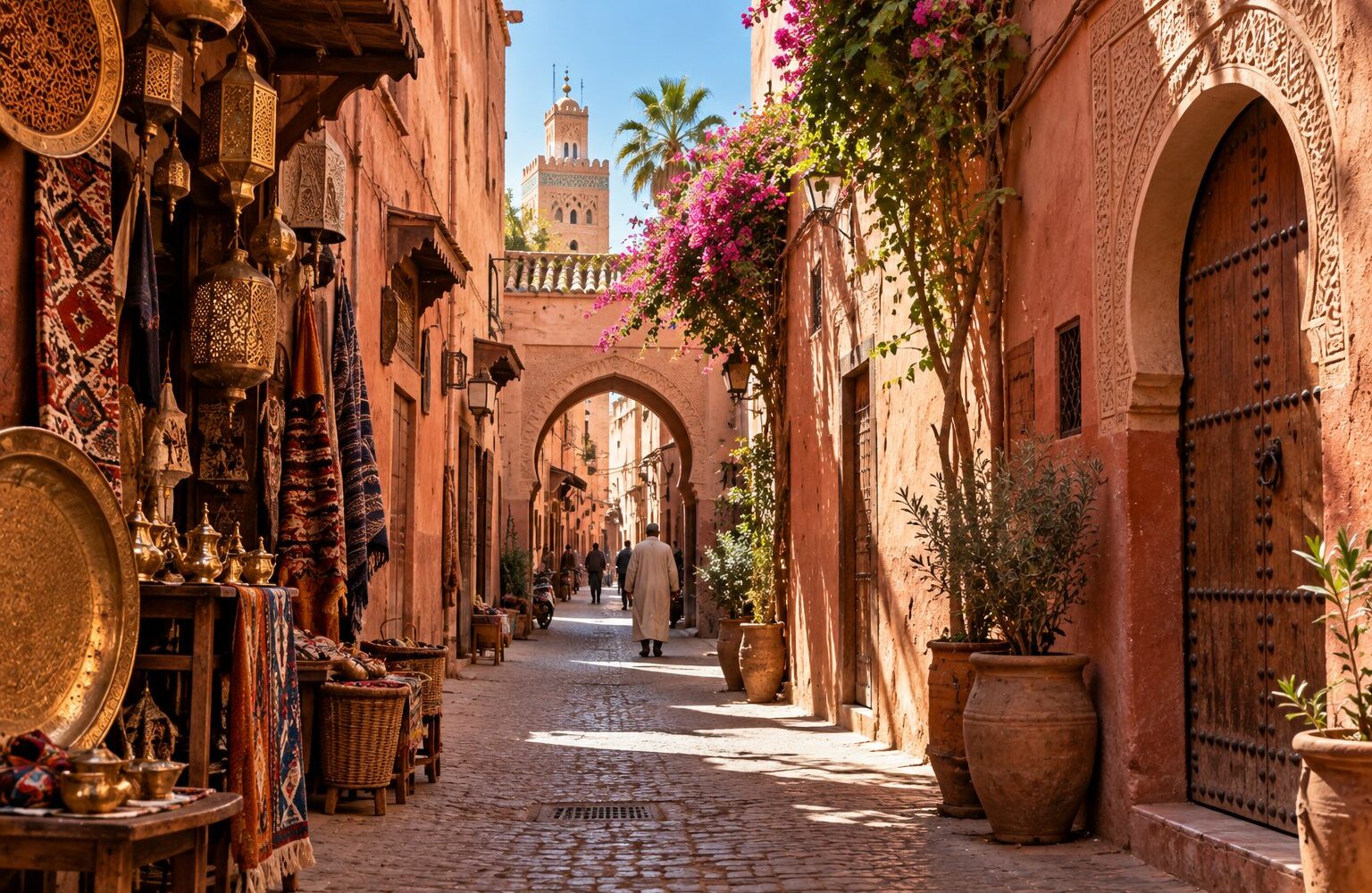
The medina covers “700 hectares” of built fabric within a total inscribed area of 1,107 hectares, whose “boundary is correctly defined by the original ramparts”. Those red rammed-earth ramparts, which gave the city its colour, enclose a plan UNESCO describes as a “tangle of lanes” and the Organization of World Heritage Cities calls an “irregular medieval plan”, organised around meeting places, mosques, madrasas and the great square of Jemaa el-Fna, separately inscribed as a cultural space of intangible heritage. To the south the Almohad kasbah forms a city within the city, with the royal palace, the Saadian tombs and El Badi.
Two elements set Marrakesh apart from the other medinas. The gardens and the palm grove, “the plantation of which is attributed to the Almoravids”, are part of the property: “its natural environment (notably the Gardens of Aguedal, Ménara and the Palm Grove)” is among the components of its universal value. And the khettaras, underground drainage galleries that tapped the water table at the foot of the Atlas and brought it to the city, made the medina possible on an arid plain; their abandonment is cited by UNESCO among the threats to integrity.
What are the monuments and building types?
In brief
The masterpieces: Koutoubia, ramparts and gates, Saadian tombs, El Badi, Bahia, Menara. And the fabric: riads, derbs, souks, fondouks, which carry criterion (v).
| Element | Period | What it represents |
|---|---|---|
| Koutoubia | Almohad, 12th c. | 77 m minaret, “an essential monument of Muslim architecture”, model for Seville’s Giralda and Rabat’s Hassan Tower; cracked in 2023, since consolidated |
| Ramparts and gates | Almoravid 1126-27, reworked | 16 km of red rammed earth, monumental gates (Bab Agnaou, Bab Doukkala, Bab el-Khemis); sections damaged in 2023, restored as an emergency |
| Kasbah | Almohad | Royal city to the south: palace, Kasbah mosque, Saadian tombs, El Badi |
| Saadian tombs | 16th c. | Dynastic necropolis in marble and zellige; rediscovered in 1917 |
| El Badi palace | Saadian, 1578-1593 | Ruins of Ahmed El Mansour’s palace, model of the palatial riad |
| Ben Youssef madrasa | Marinid, rebuilt 16th c. | Largest madrasa in Morocco, courtyard with basin, student cells |
| Bahia palace | 19th c. | Grand vizier’s residence, the peak of domestic decoration; consolidated after 2023 |
| Menara and Agdal | Almohad, reworked | Basins, pavilions, orchards; natural components of the property |
| Riads, derbs, souks, fondouks | 16th-20th c. | “The ancient habitat, rendered vulnerable due to demographic change”: criterion (v) |
Criterion (i) holds that Marrakesh “contains an impressive number of masterpieces of architecture and art, each one of which could justify, alone, a recognition of Outstanding Universal Value”. Criterion (v) aims at something else: “in the 700 hectares of the Medina, the ancient habitat, rendered vulnerable due to demographic change, represents an outstanding example of a living historic town with its tangle of lanes, its houses, souks, fondouks, artisanal activities and traditional trades”. The guides on the riad and tadelakt describe this habitat and its trades.
What threatens the medina’s integrity?
In brief
Four things according to UNESCO: urban pressure, uncontrolled alterations to the houses’ upper floors and materials, the abandonment of the khettaras, the exploitation of the palm grove. And since 2023, the earthquake.
UNESCO judges that “the integrity of the property is vulnerable due to pressure from urban development, uncontrolled alterations to upper floors and construction materials of the houses, the abandonment of the Khettaras (underground drainage galleries) and exploitation of the palm groves”. The first two aim directly at riad owners: adding floors and replacing traditional materials with concrete. The authenticity assessment is more favourable: “reconstruction and redevelopment work carried out in the heart of the historic centre generally respects the original volume and style”, and restoration “has tremendously revived the artisanal trades linked to construction”.
In 2026, by Decision 48 COM 7B.6, the World Heritage Committee added a reservation about two car-park projects inside the property, at Arset Bouachrine and at El Antaki Hospital: it asks, “before any irreversible decision is made”, for a consolidated report answering each technical concern, with “preliminary archaeological investigations”, traffic and environmental studies, and it asks that the Arset Bouachrine project be “re-examined” with measures “to restore ‘Arset Bouachrine’ to its original state and recover the original spirit of the historic garden”. It also asks for clarification of “the management system, in particular the structure in place for the property, its status, staffing, mandate and funding modalities”, and for a sustainable tourism management plan. The adopted decision does not place the property on the List of World Heritage in Danger.
What did the earthquake of 8 September 2023 change?
In brief
Damage to monuments and ramparts, 34 mosques affected including the Koutoubia, technical assessment commissions, a scientific commission for demolitions, and World Heritage Committee monitoring until 2027.
The Al Haouz earthquake, magnitude 6.8, struck on 8 September 2023. In the medina the minaret of the Kharbouch mosque on Jemaa el-Fna partly collapsed, the ramparts showed deep cracks and section collapses, and the Koutoubia suffered structural cracks; UNESCO counted 34 damaged mosques. The state of conservation report submitted by Morocco in February 2024 states that “the medina ramparts have undergone an immediate restoration campaign”, and the Director of World Heritage examined in April 2024 “the measures put in place and the consolidation work undertaken for Koutoubia Mosque and Bahia palace”.
Two Committee decisions frame what follows. In 2024 (Decision 46 COM 7B.28) it welcomed “the establishment by the State Party of technical commissions to assess the damage caused by the earthquake of 8 September 2023 and of a specialised scientific commission to examine draft demolition orders”. In 2026 (Decision 48 COM 7B.6) it noted “with appreciation the progress reported” and requested “a comprehensive technical and scientific documentation” including “detailed damage assessment reports”, “technical documentation on the interventions, including the selected options, intervention methods and monitoring system”, also for interventions “carried out under the responsibility of other administrations, such as for Koutoubia Mosque”, and “an overall, consolidated schedule of interventions”, with an updated report due by 1 December 2027.
Watch out
For an owner the earthquake has two practical consequences. Any old building in the medina should have a structural survey by an engineer before purchase or works: cracks hidden under a fresh render may date from 2023. And a demolition order for a dangerous building is no longer a purely administrative decision: it passes through a scientific commission, which protects heritage but lengthens timelines. A building declared dangerous is not “regularised”; it is surveyed, consolidated or demolished according to that commission’s opinion.
What is the protection regime, and what does it mean for an owner?
In brief
Law 22-80 and texts specific to each major monument; the Regional Inspection of Historic Monuments, which reviews permits and controls sites; the 2008 architectural charter of the medina, drawn up by the Urban Agency.
The texts: “protection measures are essentially related to different laws for the listing of historic monuments and sites, in particular Law 22-80 concerning heritage. In addition to this legislation, each of the more important monuments of the Medina of Marrakesh is protected by specific regulatory texts.” The actor: “the Regional Inspection for Historic Monuments and Sites (attached to the Ministry for Culture) is specifically responsible for the management, restoration, maintenance and conservation of the historic monuments on the one hand, and on the other, the examination of requests for building and development permits and the control of building sites in the Medina”. The tool: “the Architectural Charter of the Medina of Marrakesh, developed by the Urban Agency of Marrakesh in cooperation with the Regional Inspection”, whose implementation agreement was signed on 11 November 2008.
In practice: any project in the medina follows the procedure of the building permit with the Regional Inspection’s opinion and the charter’s requirements; added floors and non-traditional materials are the two grounds for refusal that UNESCO names as threats; and riad land tenure, often joint or under habous, is checked before any payment, as Land title vs melkia explains. The detailed rules are the subject of the guide on renovating in a medina.
When to consult a professional
A structural engineer before the architect, in Marrakesh more than anywhere
Since 2023 the order of consultations has changed: a structural engineer, for the seismic survey of the building and its neighbours; then an architect registered with the Order who knows the architectural charter and the Regional Inspection; then the maalems of the Marrakchi trades, tadelakt, zellige, wood, lime. The notary comes before all of them, for the land. Built Morocco recommends no practitioner.
Why is Marrakesh a World Heritage Site?
Under four criteria: its masterpieces (i), its decisive role in medieval town planning, imitated by Fez Jdid (ii), its character as a completed Islamic capital of the western Mediterranean (iv), and its living old habitat (v). Inscribed in 1985.
Did the 2023 earthquake destroy the medina?
No. It damaged monuments, including the Koutoubia and sections of the ramparts, 34 mosques and many houses, but the ramparts were restored as an emergency and the major monuments consolidated; the Committee’s 2026 decision does not place the property in danger.
Who reviews building permits in the Marrakesh medina?
The Regional Inspection for Historic Monuments and Sites, attached to the Ministry of Culture, in addition to the ordinary committee, under the 2008 architectural charter of the medina.
Can you add a floor to a riad in Marrakesh?
That is precisely the alteration UNESCO names as a threat to the property’s integrity and which the architectural charter controls. A project that counts on it must be checked before purchase.
What are the khettaras?
Underground drainage galleries that tapped the water table at the foot of the Atlas to supply the city and its gardens. Their abandonment is cited by UNESCO among the threats to the medina’s integrity.
Sources
- UNESCO World Heritage Centre. Medina of Marrakesh: Statement of Outstanding Universal Value, integrity, authenticity, protection and management (2009). https://whc.unesco.org/en/list/331/
- World Heritage Committee. Decision 46 COM 7B.28, Medina of Marrakesh (New Delhi, 2024). https://whc.unesco.org/en/decisions/8554
- World Heritage Committee. Decision 48 COM 7B.6, Medina of Marrakesh (Busan, 2026). https://whc.unesco.org/en/decisions/9063/
- UNESCO World Heritage Centre. State of conservation report, Medina of Marrakesh (2024). https://whc.unesco.org/en/soc/4605
- ICOMOS (1984). Evaluation of nomination 331, Medina of Marrakesh. https://whc.unesco.org/document/153207
- Hespress English (2026). UNESCO praises Morocco’s reconstruction efforts but warns against irreversible changes in Marrakech. 5 September 2026. https://en.hespress.com/142319-unesco-praises-moroccos-reconstruction-efforts-but-warns-against-irreversible-changes-in-marrakech.html