
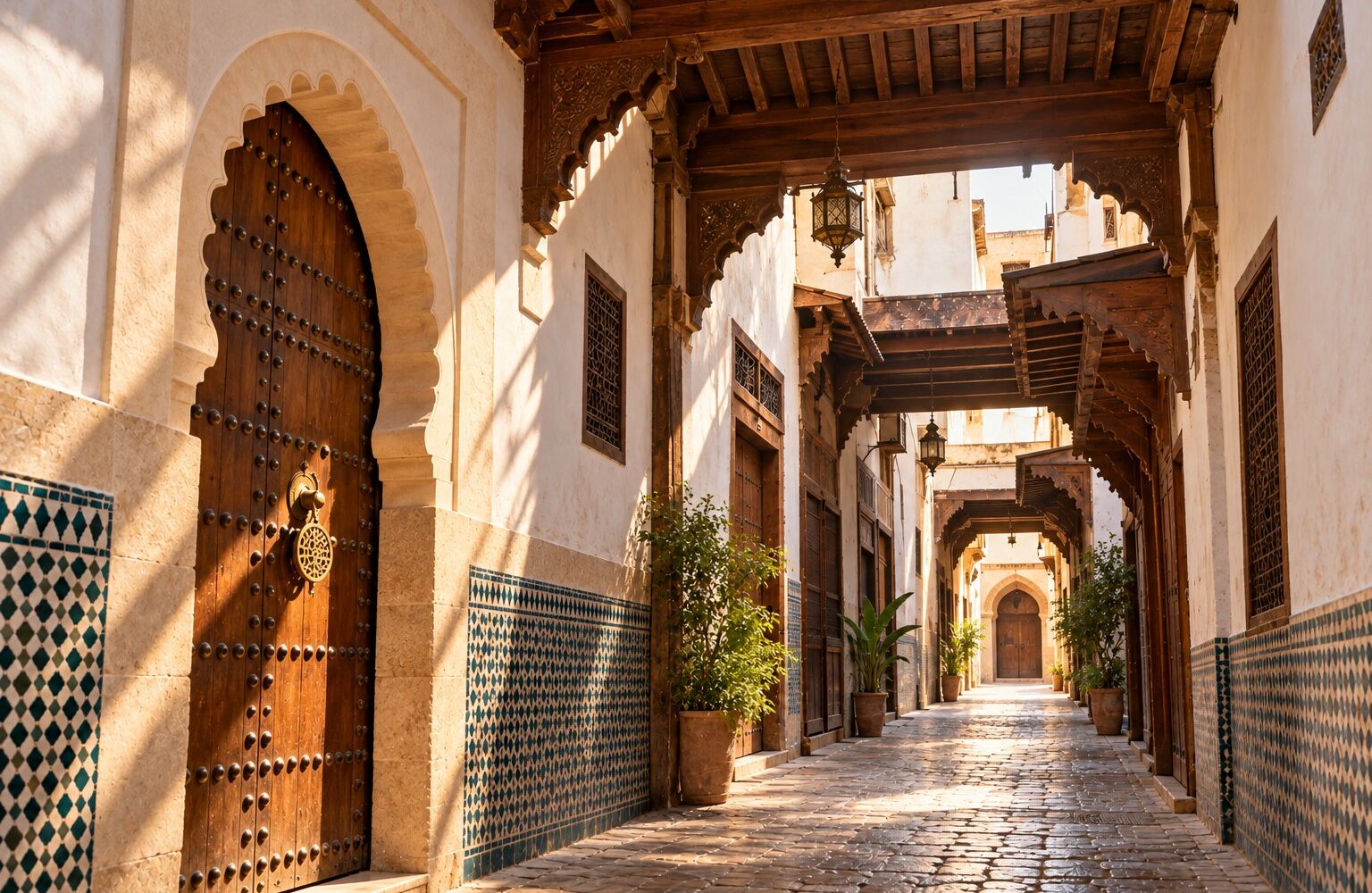
Short answer
Fez is two cities in one, Fez el-Bali and Fez Jdid, built between the 9th and 14th centuries, and the largest and best-preserved medina of the Arab-Muslim world
Founded by the Idrisids between 789 and 808 on both banks of the Fez wadi, united within a single rampart by the Almoravids in the 11th century, brought to its present size under the Almohads, Fez el-Bali received in 1276 a Marinid new town, Fez Jdid, with the royal palace and the army. Its madrasas, fondouks, mosques, fountains, palaces and houses date mostly from the Marinid peak. UNESCO inscribed it in 1981 as “one of the most extensive and best conserved historic towns of the Arab-Muslim world”, noting that its fabric “has remained remarkably homogenous and intact” and that the survival of the traditional building trades is “a major advantage”. It is protected by Law 22-80 and its 1981 implementing decree, by a non-buildable buffer zone defined as early as 1923, and managed under a 2001 development plan revised every ten years.
Fez is the city whose workshops gave Morocco its zellige, its cedar ceilings and its carved plaster, and the only Moroccan medina where almost the whole medieval fabric still stands and is lived in. It is also, for that reason, the one where owning or renovating a house involves the most rules. This guide describes its formation, structure, building types and threats from UNESCO’s assessment, then what its protection regime means for an owner. It opens the Cities section.
How did Fez take shape?
In brief
In four stages: two fortified Idrisid quarters on either side of the wadi, a single Almoravid rampart, Almohad growth, then the Marinid town of Fez Jdid.
UNESCO sums up the chronology. The medina “preserves, in an ancient part comprising numerous monumental buildings, the memory of the capital founded by the Idrisid dynasty between 789 and 808 A.D.” The original town “was comprised of two large fortified quarters separated by the Fez wadi: the banks of the Andalous and those of the Kaïrouanais”, two settlements of refugees from Córdoba and Kairouan that gave Fez its double inheritance from the start. “In the 11th century, the Almoravids reunited the town within a sole rampart and, under the dynasty of the Almohads (12th and 13th centuries), the original town (Fez el-bali) already grew to its present-day size.”
Then came the Marinid period: “a new town (Fez Jedid) was founded (in 1276) to the west of the ancient one (Fez El-Bali). It contains the royal palace, the army headquarters, fortifications and residential areas.” Fez Jdid would house the mellah, the Jewish quarter, from the 15th century. “At that time, the two entities of the Medina of Fez evolve in symbiosis forming one of the largest Islamic metropolis’s”, with “a considerable number of religious, civil and military monuments”. UNESCO notes that Fez Jdid “was inspired from the earlier town-planning model of Marrakesh”, which links Morocco’s two great medinas.
How is the medina organised?
In brief
Two walled cities, a wadi between them, quarters sloping down towards it, unpaved streets, and a tight hierarchy: artery, street, dead-end derb, house door.
Fez el-Bali occupies a basin: the quarters descend from the upper gates, Bab Boujloud to the west and Bab Guissa to the north, towards the wadi that crosses it at the bottom, where the water trades, tanners and dyers, are concentrated. The two banks keep their founders’ names, Andalusians and Kairouanis, and each has its great sanctuary: the Qarawiyyin, founded in the 9th century and described in UNESCO’s Arabic notice as the oldest university in the world, and the Andalusian Mosque. The fabric follows the logic of every Moroccan medina, taken to its extreme density: a few commercial arteries, neighbourhood streets, then dead-end derbs closed by gates, and finally the blind doors of the houses. UNESCO notes that “the unpaved urban space conserves the majority of its original functions and attribute”.
That structure is also what makes the medina hard to service and maintain: no motor traffic, materials carried by mule, terraced houses leaning on one another, so that the collapse of one threatens its neighbours.
What kinds of buildings does it contain?
In brief
Mosques and madrasas, fondouks, fountains, palaces and houses, ramparts and gates, souks. The finest date from the Marinids, who invented the Moroccan madrasa.
| Type | Function | Examples and features |
|---|---|---|
| Mosque | Prayer, teaching, neighbourhood centre | Qarawiyyin (9th c., enlarged by the Almoravids), Andalusian Mosque; square minarets |
| Madrasa | Residential college for students | Bou Inania, Attarine, Sahrij, Cherratine: courtyard with basin, cells upstairs, zellige, carved plaster and cedar; a Marinid type |
| Fondouk | Merchants’ inn and warehouse | Galleried courtyard, shops and stables below, rooms above; Nejjarine |
| Fountain (seqqaya) | Public neighbourhood water | Zellige panels and cedar canopies; fed by the wadi network |
| Palaces and houses | Housing of notables | Dar and riad with courtyard, long rooms; Fez Jdid for the royal palace |
| Ramparts and gates | Defence, control | Almoravid then Marinid enclosure; Bab Boujloud, Bab Guissa, Bab Ftouh, Bab Mahrouk |
| Souks and workshops | Trade and crafts | Grouped by guild: tanneries, coppersmiths, joiners, zellige cutters |
UNESCO stresses what these buildings share: an architecture “characterised by construction techniques and decoration developed over a period of more than ten centuries, and where local knowledge and skills are interwoven with diverse outside inspiration (Andalousian, Oriental and African)”. Criterion (ii) concerns the influence Fez exercised “mainly from the 12th to the 15th centuries, on the development of architecture, monumental arts and town-planning, notably in North Africa, Andalousia and in Sub-Saharan Africa”. The guide on the riad describes the courtyard house; the one on zellige, the finish of which Fez is the centre.
Why do the trades matter so much in Fez?
In brief
Because the medina is not a frozen monument but a fabric maintained by the hands that built it. UNESCO calls the survival of these trades “a major advantage” for conservation.
The authenticity assessment is explicit: “the survival of traditional architectural know-how, notably as regards architectural building and decoration trades, is a major advantage for the maintenance of the values of the property”. In Fez these trades are zellige, cut with the menqach from twice-fired tiles, carved gebs plaster, painted and pierced cedar, lime and brick. The maalem Abdellatif Hissouf recalls that Fez zellige “goes through more than fourteen steps, from the extraction of the clay in the Benjellik region”, and that its cutting supports close to 2,000 craftsmen in the city. The medina itself is the first client of its workshops: every house shored up, every fountain restored, every madrasa reopened passes through them.
The property is for that reason linked to three elements of intangible heritage inscribed by UNESCO: Arabic calligraphy, the arts of engraving on metals, and malhun, sung poetry born in craftsmen’s workshops.
What threatens the medina?
In brief
Inside, the deterioration of buildings and overcrowding; outside, uncontrolled urbanisation of the surroundings, which must stay non-buildable.
UNESCO is sober and precise: “the main problems noted are the deterioration of the buildings and the over-populated area”. The mechanism is that of every medina, aggravated by Fez’s density: large houses divided among several families or tenants, maintenance deferred, collapses that bring down neighbours, and residents who cannot afford the trades the city needs. The Ministry for Culture “endeavours, not without difficulty, to ensure that the different actors respect the authenticity of the property”.
Outward, UNESCO adds a requirement often ignored: “the surrounds of the medina are an indispensable element of the visual aspect of its environment and must be maintained as a non-constructible zone. This area is vulnerable due to pressure from uncontrolled urban development.” The hills overlooking Fez el-Bali, from which the whole medina is seen, are part of the property in the sense of its visual protection.
What is the protection regime, and what does it mean for an owner?
In brief
Law 22-80 and its 1981 implementing decree, a buffer zone defined by decrees from 1923, a 2001 medina development plan revised every ten years, and two actors: ADER-Fès for rehabilitation, the Inspection of Historic Monuments for control.
The texts, according to UNESCO: the medina “is protected by the local and national legal texts”, “notably Decree N°2-81-25 of 22 October 1981 for the enforcement of Law N°22-80 concerning the conservation of historic monuments and sites, inscriptions and art objects and antiquity”, and “the buffer zone defined by the Decrees of 23 August 1923 and 29 October 1954 adequately protects the visual integrity”. The tools: “the State adopted a Development Plan of the Medina in 2001. This plan is re-evaluated every ten years. It incorporates specific provisions for the ancient district, and it should rationalise and organize the required urban interventions.” The actors: implementation of safeguarding actions for houses threatened with collapse and rehabilitation of monuments “has been entrusted to the Agency for De-densification and Rehabilitation of the Medina of Fez”, while “the Inspection of the Historic Monuments is the responsibility of the Ministry for Culture and thus ensures the monitoring and the supervision of these projects”.
For an owner, three consequences. Any works project in the medina follows the procedure of the building permit, with the heritage service’s opinion and the medina development plan’s requirements on volumes, heights, materials and façades. Houses threatening collapse fall under a public programme, which may mean shoring, an order to carry out works or, in serious cases, intervention by the authorities. And the land, as in every medina, is often jointly owned or under habous: Land title vs melkia explains what to check before buying. The detailed rules are the subject of the guide on renovating in a medina.
Watch out
In Fez more than anywhere, a medina house is bound to its neighbours: party walls, floors bearing on them, lanes covered by upper storeys. Before buying, have an architect examine the condition of the adjoining houses and not only the one you are visiting; before removing a partition or a floor, have it checked that it does not carry the neighbour.
When to consult a professional
A Fez architect, Fez maalems, and ADER before the works
Buying or renovating in the Fez medina calls for an architect registered with the Order who knows the medina development plan, the heritage services and the access constraints; maalems trained in the Fassi trades; and a visit to ADER-Fès, which knows the state of the buildings and the programmes under way. The notary comes before all that, for the land. Built Morocco recommends no practitioner.
What is the difference between Fez el-Bali and Fez Jdid?
Fez el-Bali is the Idrisid city of the 9th to 13th centuries, around the Qarawiyyin and the Andalusian Mosque; Fez Jdid is the Marinid town founded in 1276 to the west, with the royal palace, the army and later the mellah. Together they form the medina inscribed in 1981.
Why is Fez a World Heritage Site?
For its influence on architecture and town planning from the 12th to the 15th century (criterion ii) and as an outstanding example of a medieval town and traditional occupation of land from the 9th to the early 20th century (criterion v).
Which law protects the Fez medina?
Law 22-80 on the conservation of historic monuments and sites, applied to Fez by Decree 2-81-25 of 22 October 1981, with a buffer zone defined by the decrees of 1923 and 1954.
Who handles the medina’s rehabilitation?
The Agency for De-densification and Rehabilitation of the Medina of Fez (ADER-Fès) for safeguarding programmes, under the supervision of the Ministry of Culture’s Inspection of Historic Monuments.
Can you build around the medina?
According to UNESCO the surroundings are an indispensable element of the property’s visual integrity and must remain non-buildable; the buffer zone has been protected by decree since 1923.
Sources
- UNESCO World Heritage Centre. Medina of Fez: Statement of Outstanding Universal Value, integrity, authenticity, protection and management (2009). https://whc.unesco.org/en/list/170
- Jaoual, Y. (2026). Entre authenticité du « menqach » et avancée de la mécanisation, les artisans du zellige fassi tirent la sonnette d’alarme. Le360, 19 July 2026. https://fr.le360.ma/culture/entre-authenticite-du-menqach-et-avancee-de-la-mecanisation-les-artisans-du-zellige-fassi-tirent-la_KZDJA52AAJHWJFW2ODP7TUXAYE/
- Selkani, I. (2021). The Riads of Morocco as tourist accommodation products. RITUREM, 5(2), 42-60. https://doi.org/10.21071/riturem.v5i2.13679