Short answer
Zellige is a mosaic of glazed terracotta, cut piece by piece with a hammer and assembled face-down; Morocco has two distinct traditions, Fez’s and Tétouan’s
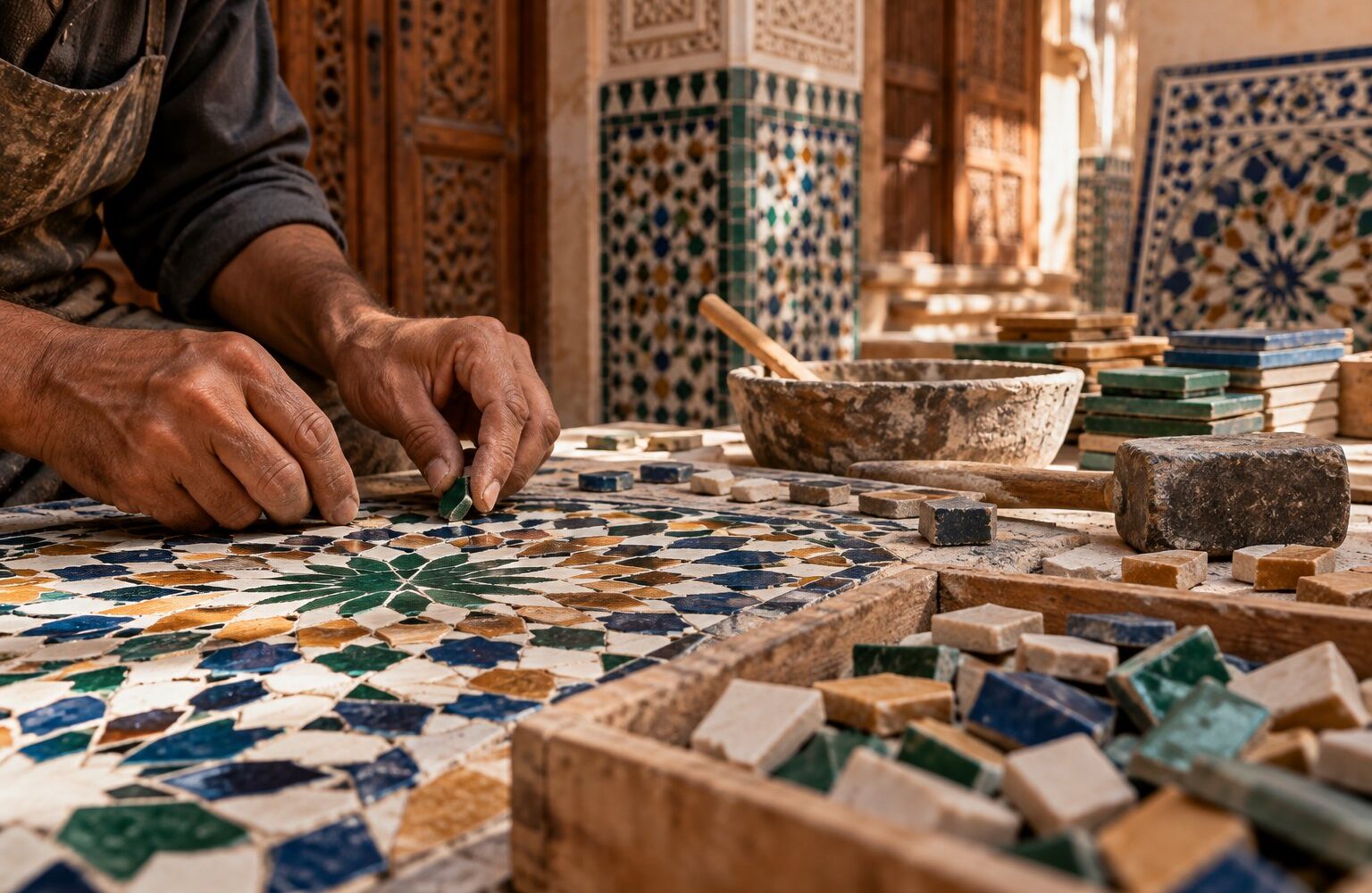
Zellige is an architectural ceramic finish made of small pieces of glazed terracotta, hand-cut from fired tiles and then assembled, face to the ground, into geometric compositions set in mortar. Attested in Morocco since the tenth century and symbolically tied to Fez, it descends from an art shared with al-Andalus. Two traditions coexist in Morocco, distinct in clay, firing and cutting: Fez zellige, the most widespread, cut with the menqach from large tiles, and Tétouan zellige, moulded piece by piece and today threatened with extinction. The price of a zellige depends on the number of pieces and on the cutting and laying work, and Built Morocco publishes no range without a source.
Zellige is the Moroccan ornament the whole world copies, in printed tiles and “zellige-effect” ceramics. The real thing is a craft of more than fourteen steps, from the extraction of a particular clay to the face-down laying of a composition only the master can see in his mind. This guide explains what zellige is, how it is made in the two Moroccan traditions, how it is laid and read, and what a buyer must check. It belongs to the materials series of the Moroccan architecture pillar.
What is zellige?
In brief
A ceramic mosaic: pieces of glazed terracotta, cut after firing, assembled in geometric patterns. It is neither a decorated tile nor painted faience.
Selkani defines it as “a clay tile enameled clay tile with a design that replicates the geometric assembly of mosaics laid”, “used in Morocco since the 10th century”, which “decorates the walls and floors” of houses, mosques, riads and hammams, whose “square form with changeable dimensions and vivid colors allow you to multiply the compositions indefinitely”. Although many places produce it, “the image of Fez remains symbolically connected to this art, which has been influenced by the Moors of Andalusia who lived in this city during its growth”.
What separates zellige from ordinary tiling comes down to three points: each piece is cut by hand after firing and glazing, from a larger tile; the pieces, in varied shapes (stars, lozenges, petals), fit together without visible joints into geometric networks; and laying is done face-down, glazed side to the ground, before the mortar is poured. Bejmat, the rectangular tile of the same clay laid in herringbone on floors, is zellige’s plain cousin, “utilized as pavement stone in the 10th century”, first in white and terracotta only, then coloured from the fourteenth century.
Where does it come from?
In brief
From an Arab-Muslim art found from Iran to Andalusia. Both Moroccan traditions, Fez’s and Tétouan’s, go back to al-Andalus, the second brought by Granadan refugees settling in Tétouan after 1492.
Zellige, explains the historian M’hamed Benaboud, professor at Abdelmalek Essaâdi University in Tétouan, “emanates from Arab-Muslim culture and exists in several countries such as Greece, Turkey, Iran or Uzbekistan”. In Morocco his research leads to the Alhambra: he traced the origin of Tétouan zellige to the Alhambra palace, where he also found what are called Fassi tiles, concluding that both Moroccan versions originate from al-Andalus and that the Granadan immigrants who settled in Tétouan after the Castilian conquest of Granada in 1492 continued to develop their craft on the Moroccan side of the strait.
The two traditions then diverged. Fez zellige “is widespread in many Moroccan cities such as Meknes, Rabat, Salé and Marrakech”; Tétouan’s “survived in the city of Tétouan for many centuries” without spreading, and “these two types are very different in terms of composition and production technique”.
How is Fez zellige made?
In brief
A local clay dug near Fez, shaped into tiles, dried, fired once, glazed, fired again, then cut piece by piece with the menqach, a sharp hammer, against a template. More than fourteen steps, all by hand.
Abdellatif Hissouf, a maalem trained in the Fez medina and a craftsman for more than forty years, reports that making zellige “goes through more than fourteen steps, from the extraction of the clay in the Benjellik region to its transformation into true works of art”. In his view, “the secret of the excellence of Fez zellige lies in its unique clay, found nowhere else in the world nor even in other regions of the Kingdom”. The sequence, as Le360 describes it from his workshops:
- Extracting and preparing the clay. Grey clay from the Fez region, soaked, settled, kneaded.
- Shaping the tiles. Lumps of clay flattened by hand into square tiles, dried in the sun.
- First firing. In a traditional kiln, under a master firer “specialist in the geometric arrangement of pieces in the kiln”.
- Glazing. The fired tile “is covered with the colours chosen by the client”.
- Second firing. “Put back in the kiln to fix the shade permanently.”
- Tracing and cutting. “Using a template and a sharp hammer, the craftsman cuts the pieces with precision”: this is the menqach work, “not a simple cut, an art that takes years of apprenticeship and that no machine can reproduce faithfully”, which supports close to 2,000 craftsmen in Fez.
- Face-down assembly. “The pieces are assembled upside down, the face of the zellige turned downwards”, according to the design, then the panel is grouted and turned over.
Benaboud describes the same logic seen from Tétouan: in Fez “a large piece of clay is used rather than small pieces”, “the clay block is fired, then the small pieces are carved individually”, and “the surface is not as smooth and shiny as that of Tétouan tiles”. That slight roughness and the variations in shade are the signature of authentic Fez zellige, not a defect.
How does Tétouan zellige differ?
In brief
In everything: an iron-rich clay that cannot be cut, pieces moulded one by one, two firings at controlled temperatures, a smoother and glossier surface, a limited palette. And in its rarity: it is at risk of disappearing.
Tétouan clay “comes from a place called Taffalin”, twelve metres down, and “is rich in iron oxide; that is why Tétouan tiles are less solid than Fassi tiles” and “it is not possible to cut these tiles”. Hence a technique the reverse of Fez’s: “the clay is first filtered”, “grinding is done by hand”, “this mixture is placed in moulds that differ in size and shape, but are all small”, and “each piece is then fired individually”. The pieces “are fired twice, before and after the addition of the mineral colouring”, between 960 and 980 °C then between 1,000 and 1,030 °C, which produces “non-homogeneous” shades, the signature of Tétouan zellige. The colours are “black, white, blue, yellow or green”.
This zellige is “on the way to extinction”: “few craftsmen remain who still keep this know-how”, demand is thinning because “it is more expensive than Fez tiles”, and “many buyers of old houses in the Tétouan medina demolish and rebuild the tiles, without considering the preservation of the zelliges”. For anyone renovating in Tétouan, keeping and restoring an old zellige rather than replacing it with Fassi work is an act of preservation.
How do you read a zellige?
In brief
By its geometric networks, built from 8-, 12-, 16- or 24-pointed stars and their derived pieces, and by its zones: dado, panel, border. Each piece’s name is a trade vocabulary.
Fez zellige compositions rest on star networks whose derived pieces bear names handed down from workshop to workshop; a linguistic study by Tazi and Brigui (2019) recorded this terminology in Fez. For the buyer, three levels of reading are enough: the number of points on the central star, which sets the complexity of the network and the number of pieces; the organisation in registers (dado, panel, crowning frieze); and the palette, which in Fez runs from white and black to blues, greens, yellows and browns, with the surface and shade irregularities of handwork. A perfectly regular, glossy zellige in uniform colours is generally an industrial product or a printed tile.
What should you check before buying or ordering?
In brief
The origin of the clay and the workshop, cutting with the menqach, glazing fixed in a second firing, the number of pieces per square metre, and a layer who works face-down. Price is judged on those, not per bare square metre.
- The clay and the workshop. Fez zellige is made in Fez with the region’s clay; craftsmen report a clay shortage that “weakens the traditional workshops” and call for “the exploitation of new clay quarries in the Benjellik region”. Ask for the provenance.
- The cutting. By hand with the menqach or by machine. Mechanisation is advancing; the masters warn that “if the machine does everything, we will become a factory like any other”. The price should reflect that choice.
- The two firings. A glaze fixed in a second firing lasts; a cold-painted colour wears.
- The number of pieces. A composition on 16- or 24-pointed stars has far more pieces than a chequerboard: that is the real cost variable.
- The laying. A trained layer assembles face-down on a drawing, pours the mortar, turns the panels and fixes them; laying “face-up” piece by piece is tiling, not zellige.
- Substrate and use. Wall, floor, basin, fountain: as glazed terracotta, zellige withstands water and traffic, but needs a stable substrate and sound mortar joints.
Watch out
Built Morocco publishes no price for zellige per square metre: it varies with the complexity of the network, manual or mechanical cutting, the workshop and the laying, and no verifiable source gives a stable range. A serious quote details the pattern, the number of pieces, the origin and the laying method.
When to consult a professional
The maalem zellaj makes, the layer assembles, the architect draws
Zellige is ordered from a workshop, ideally after visiting the production, and laid by a craftsman who masters face-down assembly; these are sometimes two trades. The architect or decorator sets the design, the registers and the surfaces, and checks the substrate’s compatibility. In a classified medina, restoring an old zellige falls under the heritage rules described in the guide on renovating in a medina. Built Morocco recommends no practitioner.
What is the difference between zellige and a “zellige-effect” tile?
Zellige is hand-cut piece by piece from a fired, glazed tile and assembled face-down; a “zellige-effect” tile is an industrial printed or moulded ceramic laid face-up. The surface and shade irregularities of real zellige are its signature.
Why is Fez zellige the most widespread?
Because its clay can be cut, which allows varied pieces to be carved from large tiles, and because its workshops spread the technique to Meknes, Rabat, Salé, Marrakech and abroad. Tétouan zellige, moulded piece by piece, stayed local.
Is zellige suitable for floors and bathrooms?
Yes, that is its historical use: floors, walls, fountains, basins, hammams. It needs a stable substrate, mortar laying and sound joints.
Why is Tétouan zellige threatened?
Because few craftsmen remain, demand is falling due to its higher price, and buyers of old houses often replace the tiles instead of restoring them, according to the historian M’hamed Benaboud.
How much does zellige cost per square metre?
Built Morocco publishes no range: the price depends on the number of pieces in the pattern, manual or mechanical cutting, the workshop and the laying. Judge a quote on those elements.
Sources
- Boujnane, I. (2022). Zellige : les tuiles de Tétouan menacées d’extinction. Médias24, 7 December 2022 (interview with M’hamed Benaboud, Abdelmalek Essaâdi University). https://medias24.com/2022/12/07/zellige-les-tuiles-de-tetouan-menacees-dextinction/
- Jaoual, Y. (2026). Entre authenticité du « menqach » et avancée de la mécanisation, les artisans du zellige fassi tirent la sonnette d’alarme. Le360, 19 July 2026. https://fr.le360.ma/culture/entre-authenticite-du-menqach-et-avancee-de-la-mecanisation-les-artisans-du-zellige-fassi-tirent-la_KZDJA52AAJHWJFW2ODP7TUXAYE/
- Le360 (2025). Art et artisanat (EP1). Comment le zellige fassi s’impose sur la carte mondiale de l’architecture. https://fr.le360.ma/culture/art-et-artisanat-ep1-comment-le-zellige-fassi-simpose-sur-la-carte-mondiale-de-larchitecture_AURWVINXFFDDVKX4O6PPOA22BU/
- Selkani, I. (2021). The Riads of Morocco as tourist accommodation products: characteristics and potentialities. Revista Internacional de Turismo, Empresa y Territorio, 5(2), 42-60. https://doi.org/10.21071/riturem.v5i2.13679