
Short answer
Tadelakt is a Marrakech lime plaster, burnished with a stone and sealed with soap, whose water resistance comes from the technique as much as from the material
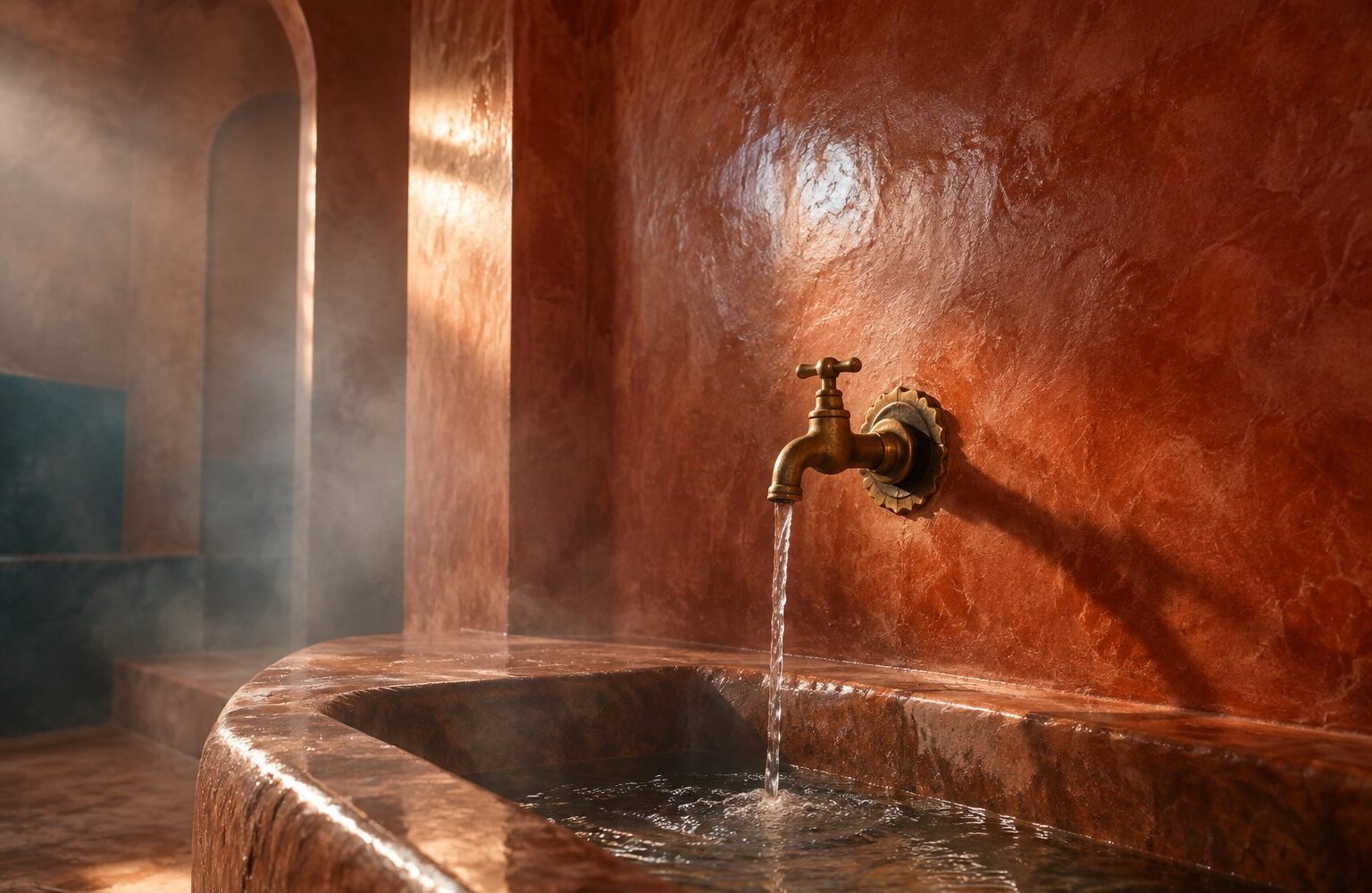
Tadelakt is a traditional plaster of the Marrakech region, prepared from a slightly hydraulic lime obtained by firing a local marly limestone. Applied in a thin coat, compacted, polished with a hard stone and treated with black olive soap, it becomes smooth, glossy and water-resistant, which has made it the finish of hammams, basins, wet rooms, floors and ceilings for centuries. It almost disappeared in the 1970s in favour of ready-mixed products and came back with the restoration of the medinas in the 1980s. Its lime has low mechanical strength: it is a finish, never a structure, and it requires a rigid substrate and a craftsman who masters the polishing.
Tadelakt is the most copied and least understood Moroccan finish. Sold everywhere as “Moroccan lime plaster”, it is often applied to the wrong substrates, with limes that are not its own, by hands that do not polish it, and then blamed for cracking or staining. This guide says what it is, according to the laboratory analyses published on Marrakech lime, how it is applied, where it belongs and where it does not, and which mistakes explain most failures. It belongs to the materials series of the Moroccan architecture pillar.
What exactly is tadelakt?
In brief
A plaster based on a particular hydraulic lime, produced around Marrakech, which already contains its own aggregates and needs only water and, if wanted, pigments.
Tadelakt’s singularity lies in its lime. The team of El Amrani, Polidoro, Ibnoussina, Fratini and colleagues, who studied the material “from the stone to the lime”, describe a plaster “realized using a particular hydraulic lime produced in the outskirts of Marrakesh”, from a carbonate stone whose nature explains the product’s properties. Their conclusion is the point to remember: “the lime for Tadelakt is not a simple binder but a ready-to-use material that does not need the addition of any aggregate but only water, and pigments if necessary”. In other words, the traditional firing of a marly limestone leaves in the lime an uncalcined fraction and a siliceous fraction that act as sand; the craftsman has nothing to proportion.
A 2024 study at the National School of Applied Sciences in Agadir confirms this composition on market samples: a lime that is “slightly hydraulic”, “mainly composed of calcite, belite, calcium oxides, silicon, and carbons”, produced “from marly limestone traditionally fired in the Marrakech region”, in which about 24 % of the particles, the finest, form the binder phase and the rest the aggregates. The authors recall that “for over eight centuries, Marrakech has been producing the lime plaster known as Tadelakt”, used “specifically to cover areas in contact with water”, and that it “consists substantially of lime, water, black cleaner, and several colorings”.
How is it applied?
In brief
On a rigid, keyed substrate: one coat of Marrakech lime mixed with water, compacted with the trowel, polished with a hard stone, then soaped. The polishing and the soap make it water-resistant.
- The substrate. A rigid, stable, rough base compatible with lime: lime or lime-cement render, brick, roughened concrete. No gypsum plaster, no paint, no flexible boards.
- Mixing. Marrakech lime and water, with lime-fast natural pigments for colour; the paste is left to rest.
- Application. One thin coat, compacted with the trowel in several passes as the surface stiffens.
- Stone polishing. While the plaster is still fresh but firm, the craftsman compresses and smooths it with a hard stone, at length, until the pores close and the sheen appears.
- Black soap. A solution of black olive soap applied and polished again: the soap reacts with the lime to form an insoluble calcium soap at the surface that completes the water-proofing.
- Drying and care. Slow hardening by carbonation; maintenance with black soap, never acid or abrasive cleaners.
Selkani sums up its use: tadelakt is “a fairly expensive ornamental coating used for the front of Riads, Mediterranean palaces, but also to cover the walls of hammams exposed to water, as well as fountains, bathtubs, basins, and sinks”; it is “a colorful lime coating that can be put to the ground both inside and outside, protecting the walls from dampness”. The cost lies in the labour of polishing, not in the material.
Why does it resist water?
In brief
Through three things together: a hydraulic lime that sets with water, a surface compressed by polishing, and a surface layer of calcium soap. None of the three is enough alone.
Being slightly hydraulic, Marrakech lime contains belite, a calcium silicate that sets on contact with water; that is what distinguishes it from a pure air lime. But tadelakt’s water-tightness is first mechanical and chemical: stone burnishing reduces surface porosity, and the black soap, reacting with calcium hydroxide, forms a water-repellent film. A Marrakech lime plaster merely trowelled, without polishing or soap, is not tadelakt and is not watertight.
What the material is not must also be said. The Agadir study measured the compressive strength of Marrakech lime concretes: “not exceeding 1 MPa in the best cases”, a very low value due “to the sandy nature of the aggregates and the traditional lime production process, which does not allow for effective quality control of the final product”. Tadelakt is a finish a few millimetres thick on a substrate that carries the load; it carries nothing itself, and its quality varies from one kiln to another.
Where does it belong, and where does it not?
In brief
Right for wet-room walls, hammams, basins, washbasins, fireplaces, ceilings, lightly used floors. Not advised for walk-in showers without precautions, kitchen floors, flexible substrates, standing acidic water.
| Use | Suitable? | Why |
|---|---|---|
| Bathroom and hammam walls | Yes | Historical use; resists damp and splashes if polished and soaped |
| Basins, washbasins, built bathtubs | Yes, with care | Traditional use; standing water and detergents call for regular re-soaping |
| Walk-in shower floor | With reservations | Permanent water, limescale, acidic products: ages fast without strict care; put a waterproofing layer under the plaster |
| Living-room floors, covered terraces | Yes if traffic is moderate | Old use; scratches, protect with soap and wax |
| Kitchen worktops | Not recommended | Food acids (lemon, vinegar) attack lime; grease stains |
| External façades | Yes, regionally | Historical use in Marrakech; rain and frost exposure to be assessed elsewhere |
| Plasterboard, wood, panel substrates | No | Flexible or incompatible substrate: cracking and detachment |
Why did it almost disappear?
In brief
Because ready-mixed industrial plasters were faster. It came back in the 1980s with the restoration of the riads and the interest in traditional architecture.
The authors of the Agadir study report that “the Tadelakt method almost disappeared from Morocco in the early 1970s, in favor of new premixed ingredients that allowed for a faster application process”, and that “renewed interest in traditional architecture, particularly in Marrakech, was a major factor in its return in the 1980s”. UNESCO records the same movement at the scale of the medina: the restoration of houses “has tremendously revived the artisanal trades linked to construction”, and expressly names “lime plaster (tadallakt)” among them. Tadelakt is today “appreciated all over the world for its waterproofing capabilities, durability, beauty, and variety of colors, as well as its increasingly appreciated ecological components”.
That success has a downside: worldwide demand has produced products called “tadelakt” that use neither Marrakech lime nor stone polishing. They are lime plasters, sometimes excellent ones, but of another nature; the word has become a style more than a technique.
Which mistakes explain the failures?
In brief
Wrong substrate, wrong lime, insufficient polishing, soap forgotten, acid cleaners, and tadelakt demanded where it never was.
- A substrate that moves or does not key. Plasterboard, old paint, smooth unscabbled concrete: the plaster cracks or detaches. Tadelakt wants a rigid, rough base.
- A lime that is not Marrakech’s. A pure air lime or an industrial blend contains neither the aggregates nor the hydraulicity that make the material; the result is a stucco, not tadelakt.
- Polishing cut short. Stone burnishing is long and tiring; it is what closes the pores. A matt, porous tadelakt was polished too little or too late.
- Black soap forgotten or replaced. Without the lime-soap reaction the surface stays absorbent.
- Detergent cleaning. Acids, bleach, limescale removers attack the lime and dissolve the film; only diluted black soap is suitable.
- The wrong place. Worktop, shower without waterproofing under the plaster, kitchen floor: uses the tradition never provided for.
- Expecting structural strength. A Marrakech lime concrete tops out below 1 MPa in compression; tadelakt is a skin, not a screed.
Watch out
Built Morocco publishes no price per square metre for tadelakt: the cost depends almost entirely on polishing time and the maalem’s reputation, and no verifiable source gives a range. Be wary of per-square-metre quotes that do not describe the substrate, the lime and the number of passes.
When to consult a professional
The maalem makes the tadelakt, the architect chooses where
Tadelakt is a trade: a maalem trained on Marrakech lime, who prepares the substrate, polishes with the stone and soaps. Ask to see work more than five years old in a wet room, not photographs of a fresh site. The architect or project manager decides on compatible locations and on waterproofing under the plaster where water stands. Built Morocco recommends no practitioner.
Is tadelakt really waterproof?
It resists water and damp thanks to its hydraulic lime, the stone polishing that closes the pores and the black soap that forms a calcium film. It is not a waterproofing membrane: under standing water or in a shower, a waterproofing layer under the plaster remains prudent.
Can tadelakt be made with another lime?
A polished lime plaster can be, but not tadelakt in the proper sense: Marrakech lime contains its own aggregates and a particular hydraulicity, described by laboratory analyses, that other limes lack.
Why did my tadelakt crack?
Most often because of the substrate: plasterboard, painted or smooth surface, or movement of the base. Sometimes because of too thick a coat or too fast drying. Tadelakt wants a rigid, rough, lime-compatible substrate.
How do you maintain tadelakt?
With diluted black soap, never with acid, chlorine or abrasive products. Periodic re-soaping keeps the sheen and the water repellency; wax can protect floors.
Is tadelakt suitable for a kitchen worktop?
No: food acids attack lime and grease stains it. It is a use the tradition never had.
Sources
- Aqelmoun, N., Belabid, A., Akhzouz, H., Elminor, Han., Elminor, Has. (2024). Physico-Chemical and Mechanical Characteristics of Traditional Marrakech Lime. Materials Research Proceedings, 40, 97-108 (RIPAM10). https://doi.org/10.21741/9781644903117-10
- El Amrani, A., Polidoro, C., Ibnoussina, M., Fratini, F., Rescic, S., Rattazzi, A., Magrini, D. (2018). From the stone to the lime for Tadelakt: Marrakesh traditional plaster. Journal of Materials and Environmental Sciences, 9(3), 754-762. https://iris.cnr.it/handle/20.500.14243/354019
- Selkani, I. (2021). The Riads of Morocco as tourist accommodation products: characteristics and potentialities. Revista Internacional de Turismo, Empresa y Territorio, 5(2), 42-60. https://doi.org/10.21071/riturem.v5i2.13679
- UNESCO World Heritage Centre. Medina of Marrakesh: authenticity (2009). https://whc.unesco.org/en/list/331/