
Short answer
Rammed earth is damp earth compacted in a formwork; it stands by its mass, breathes through its porosity, and lasts as long as its skin is maintained
Rammed earth, pisé in French (tabia in Arabic, allouh in Amazigh), is a slightly damp clayey-sandy earth compacted in layers inside a timber formwork to form thick, monolithic walls. It is the material of the load-bearing walls of Morocco’s ksour, kasbahs and ramparts, from Marrakesh to the oases. Its qualities are documented by research: immediate availability, very low processing energy, breathability and thermal insulation. Its weakness is single and well known: limited durability against water, erosion and capillary rise, which demands constant maintenance of the render. Laboratory tests show that an earth render stabilised with lime or gypsum resists erosion without reducing vapour permeability, whereas cement, being impermeable, condemns the wall.
Building in earth is coming back, for ecological and cost reasons, and Morocco holds one of the largest rammed-earth heritages in the world. But raw earth is not a material to improvise with: its selection, proportioning, placing and above all its maintenance follow rules the maalems knew and that the laboratory now confirms. This guide explains what rammed earth is, how it is placed, what destroys it, how it is protected, and what the regulations say. It belongs to the materials of the Moroccan architecture pillar and complements the guide on ksour and kasbahs.
What is rammed earth, and how does it differ from adobe?
In brief
Rammed earth is compacted in place inside a formwork, lift by lift; adobe is a moulded, sun-dried earth brick laid afterwards. The first makes the low thick walls, the second the upper floors, towers and decoration.
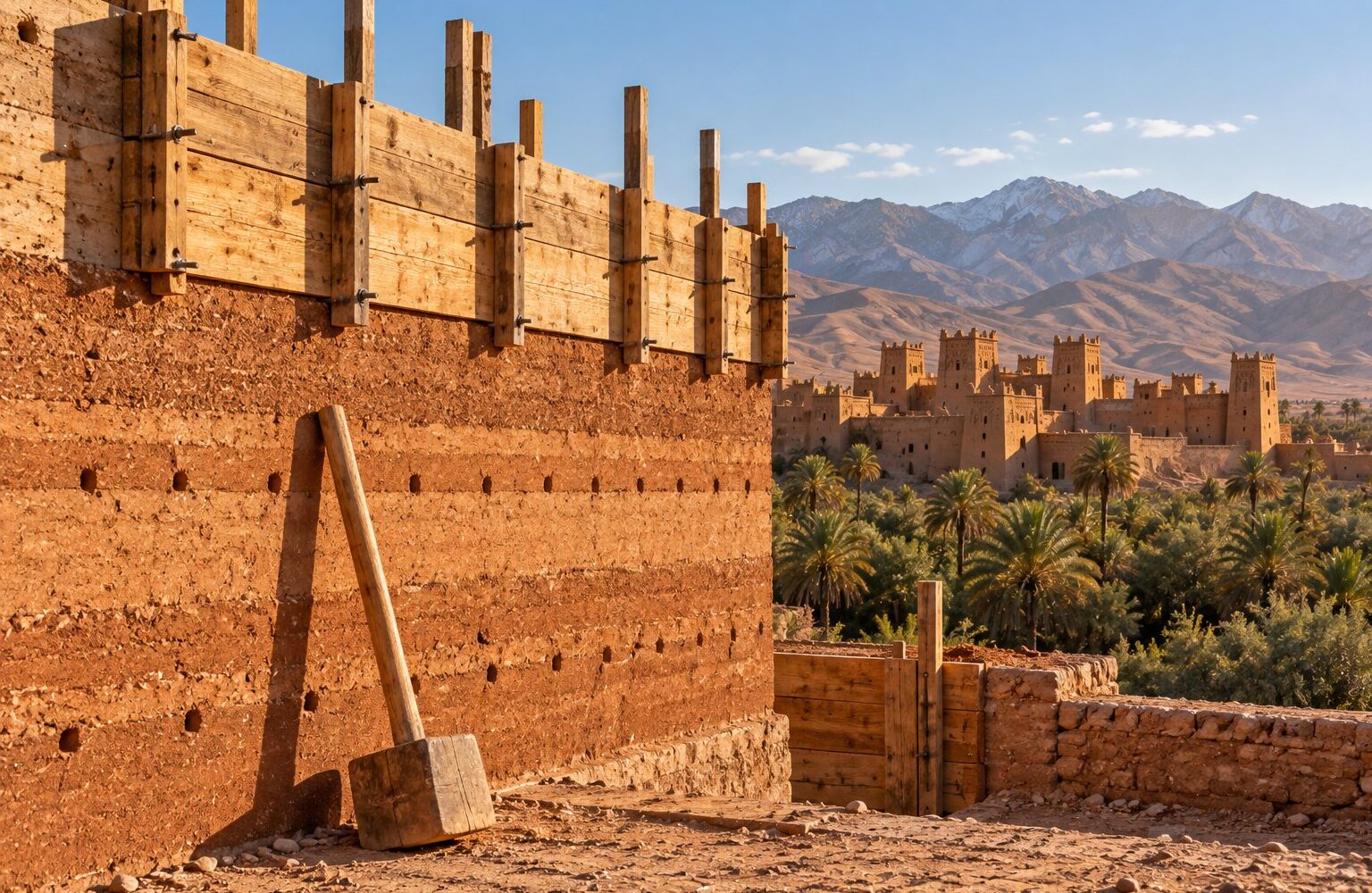
Both techniques use the same matter, an earth with enough clay to bind and enough sand not to crack, but not the same placing. Rammed earth is compacted damp, in layers a few centimetres thick, between two boards held by cross-ties, until a lift about fifty centimetres high is filled; the formwork is then moved and the wall rises in courses visible on the façades. Adobe is moulded into bricks that dry in the sun for days or weeks and are then laid in earth mortar. In the architecture of the South the massive ground floors are rammed earth and the upper, lighter, decorated parts are adobe. UNESCO describes at Aït-Ben-Haddou upper sections “decorated with motifs in clay brick” set on rammed-earth walls.
A suitable earth is a clayey-sandy silt. The one that the Italian-Moroccan team of Mattone and Ibnoussina took 22 km from Marrakesh, “more or less compact clayey silt”, classified as “silty sand” with a liquid limit of 31 % and a plasticity index of 11 %, contained “quartz, feldspars, traces of iron oxides and clay minerals (illite 45%, kaolinite 30%, chlorite 25%)”. This is not the surface topsoil, which was excluded, nor pure clay: it is the subsoil, between twenty centimetres and two metres down.
What are its qualities?
In brief
A local, almost free material with very low embodied energy, which regulates humidity and temperature. These are measured qualities, not a slogan.
Mattone and colleagues sum up what research establishes: earth “is widely available in nature at an extremely low price; it is used without the necessity of special transformations; it requires a reduced energy amount for its processing and allows to work with a minimum impact on the environment; it gives the opportunity to build high living comfort structures, thanks to its breathability and thermal insulation”. To this rammed earth adds mass: a 50 cm wall of compacted earth stores the day’s heat and releases it at night, which explains why ksour are cool in summer and mild in winter, and why UNESCO judges these constructions “perfectly adapted to the climatic conditions”.
What destroys it?
In brief
Water, in every form: rain at the wall head, run-off down the faces, capillary rise at the base, and above all moisture trapped behind an impermeable render. Then wind, and abandonment.
“The only drawback of these architectures is the limited durability of the material against the aggressive action exerted by external agents (such as rainwater, capillary rise, erosion, wind, anthropic action) that makes it necessary a constant maintenance.” The three weak points of a rammed-earth wall are known to builders: the wall head, where rain seeps in if the roof or coping fails; the base, where ground water rises by capillarity and splash erodes the foot, hence stone plinths; and the face, which run-off gullies once the render is gone. Abandonment makes everything worse: a render not redone after two rainy seasons opens the way, and UNESCO observes at Aït-Ben-Haddou that “the earthen buildings are very vulnerable due to lack of maintenance and regular repair resulting from the abandonment of the ksar by its inhabitants”.
Watch out
The most destructive modern mistake is a cement render on an earth wall. Being impermeable, it stops the wall drying; moisture builds up behind it, the earth disintegrates, and the wall bursts or collapses from inside with nothing visible beforehand. At Aït-Ben-Haddou a control committee exists precisely to keep cement out; the few concrete lintels that escaped its vigilance “have been hidden by earthen rendering”.
How do you protect an earth wall without suffocating it?
In brief
With an earth render, possibly stabilised with lime or gypsum, renewed regularly. Tests show these stabilisers resist erosion and keep vapour permeability; straw weakens adhesion.
The study by Mattone, Ibnoussina and colleagues compared in the laboratory, on a Moroccan earth, a plain earth render and renders stabilised with 15 % lime or 20 % gypsum by weight of earth, with and without straw, in two coats (a base coat about 1.5 cm in coarse earth, a finish about 0.5 cm in sieved earth). The results are clear:
| Test | Plain earth | Earth + lime (15 %) | Earth + gypsum (20 %) |
|---|---|---|---|
| Erosion (drip, Geelong test) | Failed | No erosion | No erosion |
| Erosion (jet, spray test) | High | None | Reduced |
| Capillary absorption | Reference | Increased | Reduced |
| Adhesion (shear) | Reference | Good | Best |
| Vapour permeability | 100 % | 96 % | 97 % |
| Colour | Reference | Slightly yellower | Slightly whiter |
The authors conclude that “with regard to water resistance, the addition of lime gives the best results”, that “gypsum has reduced [capillary absorption] while the addition of lime has made the plaster more absorbent”, that “the presence of straw generally worsens the behaviour” for adhesion, that “the permeability to water vapour keeps almost unchanged in all the plasters”, and that “in summary we can say that gypsum is the additive that allows the larger performances’ improvement”. The lime used was a Moroccan natural hydraulic lime, the gypsum a soluble anhydrite; both are “easily available on the Moroccan territory”. Two reservations: these are laboratory results, “it remains to determine the in situ plasters’ behaviour”; and a render, even stabilised, is renewed, it does not dispense with maintenance.
How do you build in rammed earth today?
In brief
As before for the material and the ramming, plus a plinth against water, a ring beam and an overhanging roof, and an engineering office that knows the seismic regulation specific to earth.
- Select and test the earth. A clayey-sandy silt from the subsoil, without topsoil; simple shrinkage and cohesion tests, or a laboratory grain-size analysis.
- Isolate the wall from the ground. A stone or concrete plinth 40 to 60 cm above ground level with a capillary break: the foot of the wall must never touch water.
- Ram in lifts. Earth at ramming moisture (it holds in a ball without weeping), 10 to 15 cm layers compacted, formwork moved lift by lift; corners and junctions done with care.
- Tie and cap. A ring beam at the wall head (timber, or reinforced concrete on an isolating bed) for overall stability, then a roof or coping that overhangs to throw rain clear.
- Render after drying. An earth render, stabilised or not, applied once the wall has finished drying and shrinking; never cement.
- Maintain. Inspection after every rainy season: wall head, base, cracks; repair of eroded render.
On the regulatory side, a raw-earth building is a building like any other: subject to the building permit, to an architect’s plans where the law requires them, and to the zone’s planning documents. A seismic regulation specific to earthen construction exists in Morocco (RPCTerre 2011), distinct from the RPS for concrete and masonry buildings; we have not read its text and refer readers to an engineering office for its requirements. The guide on the building permit describes the common procedure.
And to restore an old rammed-earth wall?
In brief
Same matter, same logic: diagnose the water, make the base and head sound, fill losses with compatible earth, re-render in earth. For listed sites, CERKAS and Law 22-80.
Restoring an earthen building starts with water: where it comes from, where it gets in, why it no longer gets out. Then consolidation with compatible earth, rammed-earth or adobe fills of the same nature, and re-rendering in earth, possibly stabilised. Foreign materials, cement, strong hydraulic mortars, resins, are to be excluded: they create hard, impermeable spots that concentrate decay. For inscribed or listed sites, “protection measures essentially relate to the different laws for the listing of historic monuments and sites, in particular the Law 22-80”, and CERKAS is the reference institution for the techniques.
When to consult a professional
An earth maalem and an engineer who has read the regulation
Rammed earth is built with maalems trained in the technique, increasingly rare, and designed with an architect and an engineering office who have built in earth before and know the seismic regulation that applies. For a restoration, CERKAS at Ouarzazate and the heritage services are the contacts. A materials laboratory can qualify your earth before the site opens. Built Morocco recommends no practitioner.
What is the difference between rammed earth and adobe?
Rammed earth is damp earth compacted in a formwork, lift by lift, to make monolithic walls; adobe is a moulded raw-earth brick, dried in the sun, then laid. Ksour combine both: rammed earth below, adobe above.
Does an earth wall withstand rain?
Yes, as long as its head is capped, its base isolated from the ground and its face rendered. Tests show that an earth render stabilised with lime or gypsum resists erosion; plain earth does not.
Can earth be rendered with cement?
No. Cement is impermeable, traps moisture in the wall and destroys it from inside. Earth, lime or gypsum renders let the wall breathe.
Do you need a permit to build in earth?
Yes, the ordinary building permit, with an architect’s plans in the cases provided by law, and compliance with the seismic regulation specific to earthen construction.
How long does a rammed-earth wall last?
Centuries if maintained, as Morocco’s ramparts and ksour show; a few years of abandonment are enough to ruin it. Lifespan depends on maintenance, not on the material.
Sources
- Mattone, M., Ibnoussina, M., Rescic, S., Fratini, F., Magrini, D., Mecchi, A. M., Nocairi, M. (2016). Stabilization of earthen plasters: Exchange of knowledge and experiences between Italy and Morocco. Journal of Materials and Environmental Science, 7(10), 3647-3655. https://iris.polito.it/retrieve/handle/11583/2665283/144009/397–JMES-Mattone.pdf
- UNESCO World Heritage Centre. Ksar of Ait-Ben-Haddou: Statement of Outstanding Universal Value (2009). https://whc.unesco.org/en/list/444
- Aqelmoun, N., Belabid, A., Akhzouz, H., Elminor, Han., Elminor, Has. (2024). Physico-Chemical and Mechanical Characteristics of Traditional Marrakech Lime. Materials Research Proceedings, 40, 97-108. https://doi.org/10.21741/9781644903117-10