Short answer
A ksar is a fortified earthen village, a kasbah a fortified residence, a tighremt a family tower-house; all three belong to the same pre-Saharan architecture
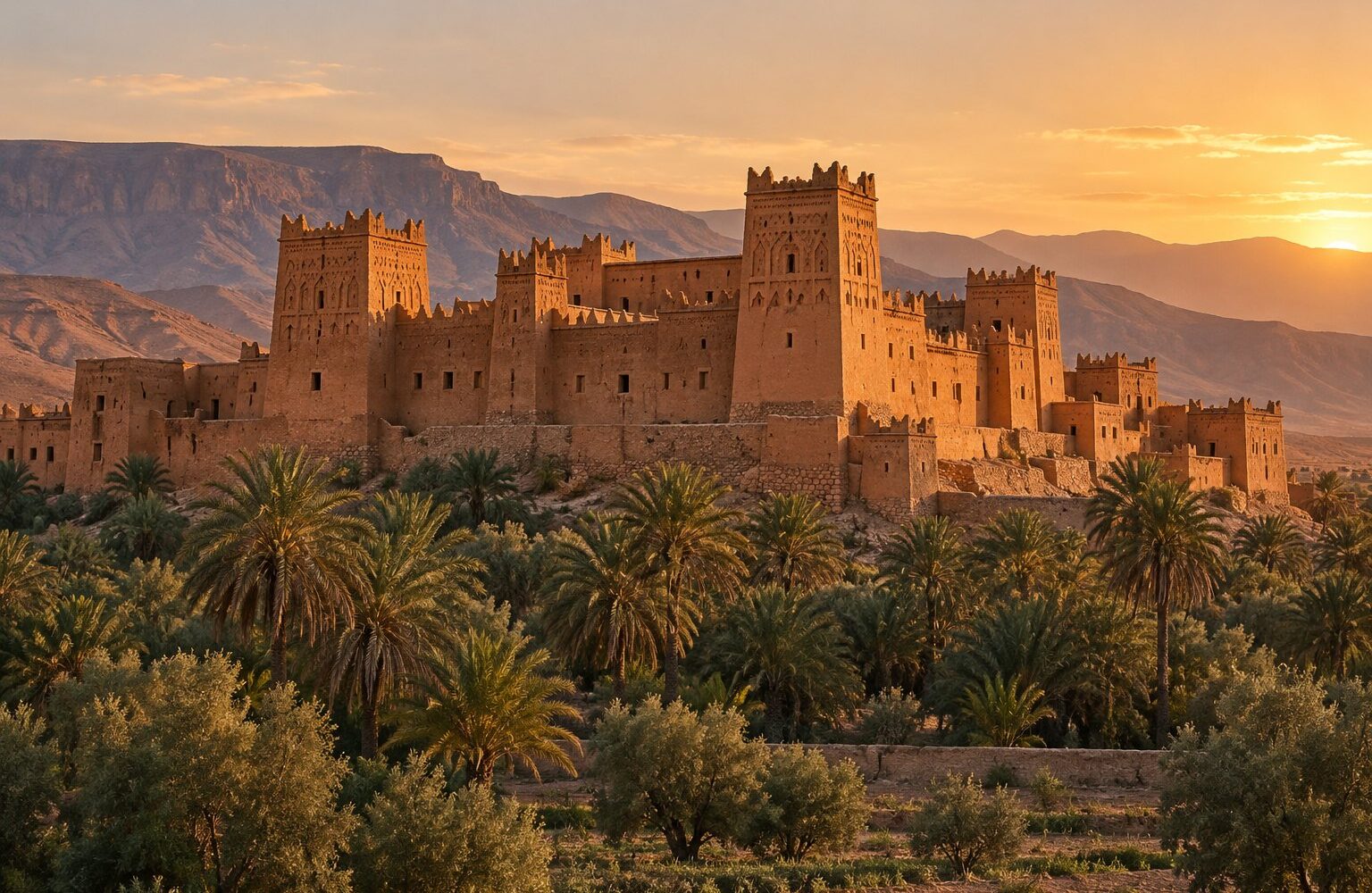
In the valleys of the Draa, Todgha, Dadès and Souss, traditional housing is built of earth: rammed earth for the walls, sun-dried brick for upper floors and decoration, palm or tamarisk wood for floors. The ksar (plural ksour) is a collective grouping of houses packed behind a wall with corner towers and a baffle gate, with mosque, square, granary and threshing floors. The kasbah is the fortified residence of a notable or a power, with four corner towers. The tighremt, an Amazigh word, is the tower-house of an extended family, two to four storeys high. Aït-Ben-Haddou, inscribed on the World Heritage List in 1987, offers according to UNESCO “a complete panorama” of this architecture; the habitat is now “vulnerable” because its inhabitants are leaving and earth demands constant maintenance.
Images of ochre ksour at the foot of the Atlas have travelled the world, mostly through cinema. They say little about what these buildings are: a coherent constructive, social and climatic system, threatened today less by time than by the departure of those who maintained it. This guide defines the three types, describes how and why they are built, draws on UNESCO’s assessment of Aït-Ben-Haddou and on recent research into earthen renders, and says what restoring an earthen building involves today. It belongs to the typologies of the Moroccan architecture pillar.
Ksar, kasbah, tighremt: what are we talking about?
In brief
Three scales of one way of building: the village, the fortress, the house. The words sometimes overlap in usage; the architecture keeps them apart.
| Type | What it is | Features |
|---|---|---|
| Ksar (ⵉⵖⵔⵎ, ighrem in Amazigh) | Collective fortified village, usually beside an oasis or a valley | Continuous wall with corner towers, baffle gate, covered lanes, terraced houses, mosque, square, collective granary, threshing floors outside the walls |
| Kasbah | Fortified residence of a caïd, a notable or a powerful family, sometimes a seat of power | Square or rectangular plan, four tall corner towers, inner court, mud-brick decoration on the upper parts |
| Tighremt | Tower-house of an extended family, standing alone or inside a ksar | Two to four levels: animals and stores below, living quarters in the middle, terrace and towers on top; geometric decoration under the cornices |
UNESCO describes Aït-Ben-Haddou as “a mainly collective grouping of dwellings” where, “inside the defensive walls which are reinforced by angle towers and pierced with a baffle gate, houses crowd together – some modest, others resembling small urban castles with their high angle towers and upper sections decorated with motifs in clay brick”. Those “small urban castles” are the kasbahs and tighremts housed inside the ksar. The community areas “include a mosque, a public square, grain threshing areas outside the ramparts, a fortification and a loft at the top of the village, an caravanserai, two cemeteries (Muslim and Jewish) and the Sanctuary of the Saint Sidi Ali or Amer”.
Where is this architecture found?
In brief
On the southern slopes of the High Atlas and in the pre-Saharan valleys: Draa, Todgha, Dadès, Souss, Ounila, along the old caravan routes.
Aït-Ben-Haddou, “located in the foothills on the southern slopes of the High Atlas in the Province of Ouarzazate”, is “the most famous ksar in the Ounila Valley” and “an eminent example of a ksar in southern Morocco illustrating the main types of earthen constructions that may be observed dating from the 17th century in the valleys of Dra, Todgha, Dadès and Souss”. Its position is explained by trade: the site “was also one of the many trading posts on the commercial route linking ancient Sudan to Marrakesh by the Dra Valley and the Tizi-n’Telouet Pass”. Ksour line the oases and the routes; their wall protects harvests and people, and their collective granary, the agadir, keeps the community’s reserves.
UNESCO notes that “the oldest constructions do not appear to be earlier than the 17th century, although their structure and technique were propagated from a very early period in the valleys of southern Morocco”. Raw earth is not dated like stone: a maintained rammed-earth wall is rebuilt in layers, and living buildings are rarely of one period.
How are they built?
In brief
Rammed earth for the low, thick walls, sun-dried brick (adobe) for upper floors, towers and decoration, wood for floors and lintels, earth render renewed regularly. Nothing is fired, everything is local.
Load-bearing walls are rammed earth: damp earth compacted in layers inside a timber formwork, rising in successive lifts, 50 cm thick or more, which gives the ground floors their thermal mass. The upper parts, towers and top storeys, are sun-dried earth bricks, lighter and easier to decorate: the geometric motifs “in clay brick” that UNESCO notes under the cornices are bricks laid proud or recessed. Floors rest on palm, tamarisk or poplar beams covered with reeds and beaten earth. Openings are small, for coolness and defence.
Aït-Ben-Haddou’s authenticity rests on the fact that “the construction materials used still remain earth and wood”. UNESCO records that “the inclination to introduce cement has so far been unsuccessful, thanks to the continued monitoring of the ‘Comité de contrôle des infractions’ (Rural Community, Town Planning Division, Urban Agency, CERKAS). Only a few lintels and reinforced concrete escaped its vigilance, but they have been hidden by earthen rendering. Particular attention is also paid to doors and windows giving on to the lanes, to ensure that the wood is not replaced by metal”. The guide on rammed earth details the material and its upkeep.
Why does this architecture suit the climate?
In brief
Thermal mass of thick walls, covered lanes, narrow courts, small openings: the day’s heat is damped, the night’s coolness kept.
UNESCO judges that “the earthen constructions are perfectly adapted to the climatic conditions and are in harmony with the natural and social environment”. Materials research says why: earth “gives the opportunity to build high living comfort structures, thanks to its breathability and thermal insulation”, it “is widely available in nature at an extremely low price”, is used “without the necessity of special transformations” and “requires a reduced energy amount for its processing”. Rammed-earth walls store the day’s heat and release it at night; covered lanes and narrow courts stay in shade; the ksar’s compactness reduces exposed surfaces. The “compact grouping, closed and suspended”, in UNESCO’s words, is a climate machine before it is a backdrop.
Why is this habitat vulnerable?
In brief
Because earth demands constant maintenance and the inhabitants are leaving. An empty ksar deteriorates within a few rainy seasons.
Criterion (v) of the inscription concerns “the traditional earthen habitat, representing the culture of southern Morocco, which has become vulnerable as a result of irreversible socio-economic and cultural changes”. UNESCO is precise about the mechanism: “the earthen buildings are very vulnerable due to lack of maintenance and regular repair resulting from the abandonment of the ksar by its inhabitants”. Research confirms that “the only drawback of these architectures is the limited durability of the material against the aggressive action exerted by external agents (such as rainwater, capillary rise, erosion, wind, anthropic action) that makes it necessary a constant maintenance”.
The cycle is well known: families leave the ksar for modern houses by the road, the render is no longer redone after the rains, water seeps in at the top of the walls and at the base, the timber floors rot, and the building collapses from top to bottom. At Aït-Ben-Haddou “the large houses in the lower part of the village, with well conserved decorative motifs, are regularly maintained”; elsewhere, hundreds of ksour and kasbahs no longer are.
What do you need to know to restore or build in earth today?
In brief
That listed sites fall under Law 22-80 and CERKAS; that cement is earth’s enemy; that lime- or gypsum-stabilised renders resist erosion without suffocating the wall; and that the building permit applies to earthen construction too.
For inscribed sites, “protection measures essentially relate to the different laws for the listing of historic monuments and sites, in particular the Law 22-80 concerning Moroccan heritage”, and CERKAS, the Centre for the conservation and rehabilitation of the architectural heritage of Atlas and sub-Atlas zones, “ensures coordination in the implementation” of the management plan. Outside listed sites, the ordinary building permit applies to any construction, earthen or not; in rural settlements covered by a development plan, “obtaining prior authorisation is required for any construction”, as the guide on planning documents explains.
Technically, the lesson of conservation sites and laboratories is constant: a cement render on an earth wall traps moisture and bursts the wall from inside; earth must breathe. The Italian-Moroccan study by Mattone, Ibnoussina and colleagues, which tested earthen renders from the Marrakesh region stabilised with products “easily available on the Moroccan territory”, lime and gypsum, concludes that “with regard to water resistance, the addition of lime gives the best results”, that the plain earth render “has not withstood the test” of erosion, that gypsum reduces capillary absorption while lime increases it, that straw “generally worsens the behaviour” for adhesion, and that “the permeability to water vapour keeps almost unchanged in all the plasters”. In other words, the skin of an earth wall can be hardened against rain without stopping it breathing, provided lime or gypsum is used rather than cement.
Watch out
A seismic regulation specific to earthen construction exists in Morocco (RPCTerre 2011), distinct from the RPS that applies to concrete and masonry; we have not read its text and do not describe its requirements. For any new earthen building, an engineering office familiar with this regulation is indispensable; for a restoration, CERKAS and the heritage services are the contacts.
When to consult a professional
The earth maalem, CERKAS, and an architect who has already built in earth
Restoring a kasbah or a tighremt is work for maalems specialised in rammed earth and adobe, who are increasingly rare; CERKAS, at Ouarzazate, is the reference institution for conservation and trains in these techniques. Building in raw earth today calls for an architect and an engineering office who have done it before and know the seismic regulation specific to the material. The land status of ksour, often collective or jointly owned, must be checked before any project, as for a medina house. Built Morocco recommends no practitioner.
What is the difference between a ksar and a kasbah?
A ksar is a collective fortified village, with mosque, square, granary and threshing floors; a kasbah is a fortified residence with four corner towers, belonging to a notable or a family, which may stand inside a ksar or alone.
What is a tighremt?
The Amazigh word for the tower-house of an extended family, two to four storeys high, with stores below, living quarters in the middle and a towered terrace on top. It is found inside ksour and standing alone in the oases.
How old are the ksour of southern Morocco?
The surviving buildings do not seem to predate the 17th century according to UNESCO, but the technique is far older; raw earth is rebuilt in layers, so living buildings are rarely of one period.
Why do ksour collapse?
Because raw earth demands constant maintenance, especially after rain, and abandonment by the inhabitants interrupts it. Water seeps in, timbers rot, the building falls.
Can an earth wall be rendered with cement?
No. Cement traps moisture in the wall and bursts it. Research shows that an earth render stabilised with lime or gypsum resists erosion while letting the wall breathe.
Sources
- UNESCO World Heritage Centre. Ksar of Ait-Ben-Haddou: Statement of Outstanding Universal Value, integrity, authenticity, protection and management (2009). https://whc.unesco.org/en/list/444
- Mattone, M., Ibnoussina, M., Rescic, S., Fratini, F., Magrini, D., Mecchi, A. M., Nocairi, M. (2016). Stabilization of earthen plasters: Exchange of knowledge and experiences between Italy and Morocco. Journal of Materials and Environmental Science, 7(10), 3647-3655. https://iris.polito.it/retrieve/handle/11583/2665283/144009/397–JMES-Mattone.pdf
- Chtouki, H. (2011). La planification urbaine au Maroc : état des lieux et perspectives. FIG Working Week 2011. https://www.fig.net/resources/proceedings/fig_proceedings/fig2011/papers/ts06a/ts06a_chtouki_5236.pdf