
Short answer
Meknes is the capital Moulay Ismail built in earth at the end of the 17th century: a medina and an imperial city enclosed in 15-metre ramparts, inscribed in 1996, and some of whose attributes UNESCO judges “already compromised”
Founded in 1061 by the Almoravids as a stronghold, Meknes became under Moulay Ismail (1672-1727) “the first great work of the Alaouite dynasty”: an imperial city of palaces, granaries, stables, basins and gardens in Hispano-Moorish style, enclosed by high walls pierced by nine monumental gates, set beside the Almoravid and Marinid medina. UNESCO inscribed it under criterion (iv) alone, as “an exemplary testimony of the fortified towns of the Maghreb” illustrating “the specificities of earthen architecture (cobwork)” of Maghreb towns. Its assessment is the harshest of any Moroccan medina: the urban structure “has become vulnerable due to rapid change and only poorly controlled development”, some buildings are “very vulnerable due to inappropriate renovation or reconstruction”, and “a management plan for the property is not yet available”. Protection rests on Law 22-80, a municipal Service for Historic Monuments created in 2003, and an architectural charter and medina development plan in preparation.
Meknes is the imperial city visited least and with the most to lose. Its rammed-earth ramparts, the highest in Morocco, enclose kilometres of blind corridors, monumental granaries and a compact medina where houses collapse faster than they are restored. UNESCO says so plainly, and the Bab Berdieyinne minaret disaster of February 2010 made the point. This guide describes the city’s formation, its two ensembles, its monuments and its material, then what its incomplete protection regime means for anyone who owns or renovates there. It belongs to the Cities section.
How did Meknes become a capital?
In brief
An Almoravid stronghold of 1061, named after the Meknassa tribe, swelled by refugees from Andalusia, then chosen by Moulay Ismail in 1672 to build, over fifty-five years, an imperial city to his measure.
UNESCO traces the origin: “founded in 1061 A.D. by the Almoravids as a military stronghold, its name originates from the great Berber tribe Meknassa who dominated eastern Morocco as far back as the Tafilalet in the 8th century. Geographically, it is remarkably located in the Saïss Plain between the Middle Atlas and the pre-rifan massif of Zerhoun.” ICOMOS adds that “refugees from the Moorish centres in Andalusia that fell to Christian forces also helped to swell the population”. Then came the reign: “the founder of the Alaouite dynasty, Moulay Ismaïl (1672-1727), made Meknes his capital city” and undertook “the creation of a new imperial city”, “built in the Hispano-Moorish style”, “impressive in both extent” and monuments.
The inscribed property, ICOMOS specifies, “is that which constituted the capital city during the reign of Moulay Ismaïl”. UNESCO stresses what that represents: “in addition to its architectural interest of being built in the Hispano-Moorish style, Meknes is of particular interest as it represents the first great work of the Alaouite dynasty, reflecting the grandeur of its creator”, and “a remarkable approach of urban design, integrating elements of both Islamic and European architecture and town planning”.
How is the historic city organised?
In brief
Two ensembles separated by ramparts: the medina, compact and overcrowded, and the imperial kasbah, made of vast open areas, long corridors between high blind walls, palaces, granaries and gardens.
“The two ensembles are surrounded by a series of ramparts that separate them from one another.” UNESCO contrasts them point by point: “the Medina constitutes a compact and overcrowded ensemble while the Kasbah comprises vast open areas. The imperial city is differentiated from the Medina by its long corridors between high blind walls, the sombre maze of Dar el-Kbira, the wealth of Qsar el-Mhansha, the extensive gardens and the robustness of the towers and bastions.” Those corridors, winding between two walls for hundreds of metres, are the signature of Meknes: a city of power designed to isolate, defend and impress, whose footprint makes the kasbah larger than the medina itself.
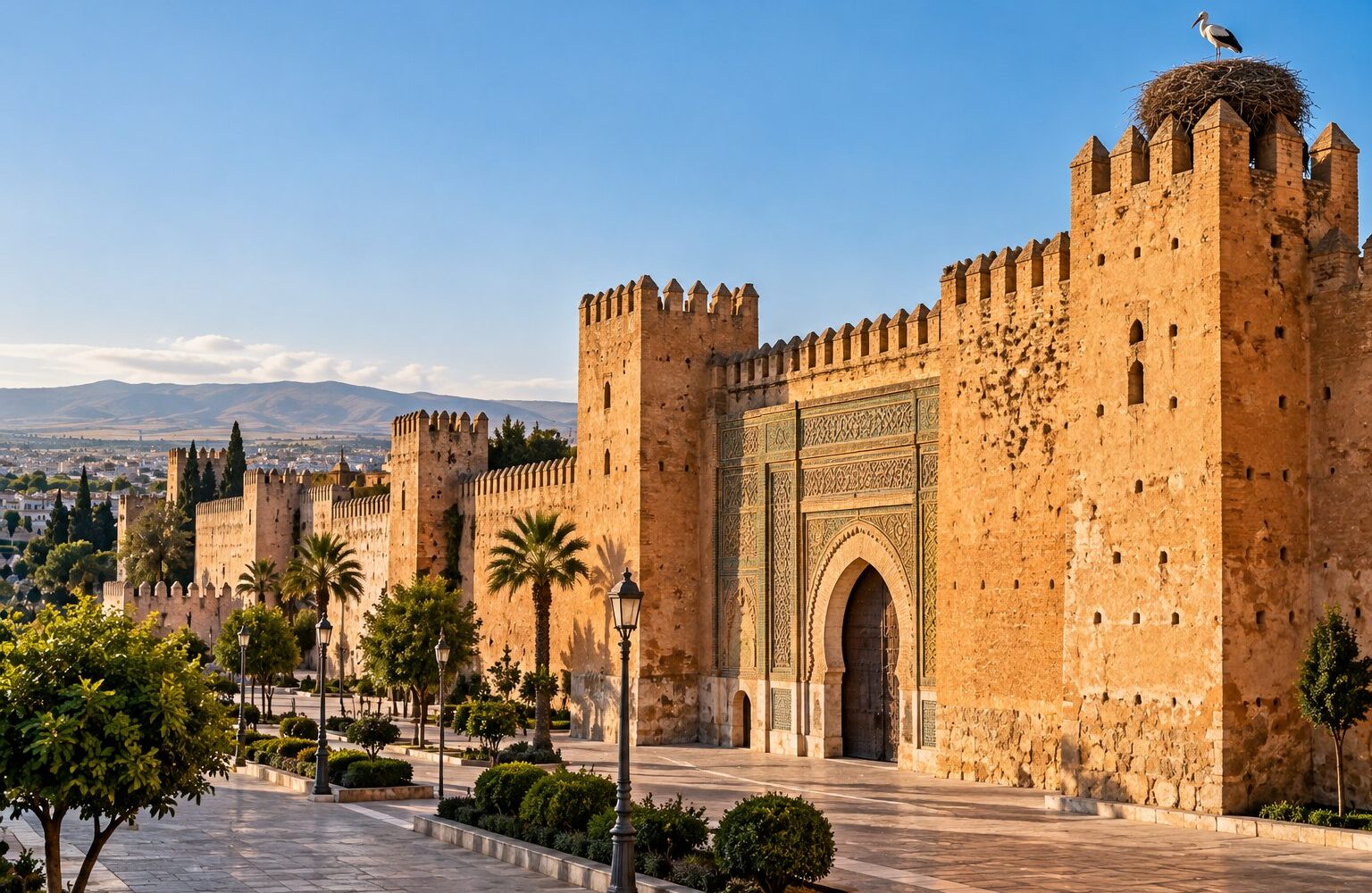
The ramparts are the major monument. Criterion (iv) holds that “Meknès is distinctive by the monumental and voluminous aspect of its ramparts reaching 15 metres in height” and “is considered as an exemplary testimony of the fortified towns of the Maghreb”. Behind them, “pierced by nine monumental gates”, Bab Mansour first among them, UNESCO counts “twenty-five mosques, ten hammams, palaces, vast graneries, vestiges of fondouks (inns for merchants) and private houses, testimonies to the Almoravid, Merinid and Alaouite Periods”.
What are the monuments?
In brief
Bab Mansour and the gates, Dar el-Kbira, Qsar el-Mhansha, the Heri es-Souani granaries and stables, the Agdal basin, the Mausoleum of Moulay Ismail, the Bou Inania madrasa, the so-called Kara prison, and Place el-Hedim between medina and kasbah.
| Element | What it is |
|---|---|
| Ramparts and nine gates | Rammed earth, up to 15 m high; Bab Mansour el-Aleuj, completed under Moulay Abdallah, the most famous gate in Morocco |
| Dar el-Kbira | Moulay Ismail’s great palace, a “sombre maze” in ruins within the kasbah |
| Qsar el-Mhansha | Palace whose “wealth” UNESCO singles out |
| Heri es-Souani and Sahrij es-Souani | Vaulted granaries and stables, the Agdal water reserve basin |
| Mausoleum of Moulay Ismail | Tomb of the founder, restored in the 20th century |
| Bou Inania madrasa | Marinid college in the medina, 14th century |
| Habs Kara | Vast underground halls known as the prison, in the kasbah |
| Place el-Hedim | The esplanade separating medina and kasbah, in front of Bab Mansour |
| Mosques, hammams, fondouks, houses | Twenty-five mosques, ten hammams, vestiges of fondouks and private houses |
What binds these monuments is their material: Meknes “illustrates the specificities of earthen architecture (cobwork) of sub-Saharan towns of the Maghreb”, and UNESCO has placed it in its World Heritage Earthen Architecture Programme. The ramparts, granaries and corridors are rammed earth, sometimes metres thick, and obey the rules described in the guide on rammed earth: cap, drain, render, never cement.
Why does UNESCO judge Meknes vulnerable?
In brief
Rapid and poorly controlled development, inappropriate renovation and reconstruction, erosion of the fabric’s features, a weakened buffer zone: UNESCO writes that “some of its attributes are already compromised”.
The assessment does not spare the city. On integrity: “although certain key attributes of the city and ancient imperial capital that reflect the Outstanding Universal Value are well preserved, others are in need of conservation measures. Generally, the urban structure and the characteristics of the urban fabric of Meknès have become vulnerable due to rapid change and only poorly controlled development, as has the surrounding buffer zone.” On authenticity: “some buildings have become very vulnerable due to inappropriate renovation or reconstruction, and the urban fabric is also rendered fragile by the erosion of features. In general, the capacity of the property to express its Outstanding Universal Value should be strengthened as some of its attributes are already compromised.”
On 19 February 2010 the minaret of the Bab Berdieyinne mosque in the medina collapsed during Friday prayers, killing several dozen people; the Director-General of UNESCO deplored the loss of life and offered support. For the medina the collapse was the alarm signal on the state of old buildings, whether of earth, brick or stone, and on the urgency of a systematic survey.
What is the protection regime, and what does it mean for an owner?
In brief
Law 22-80; a municipal Service for Historic Monuments created in 2003, working with the Regional Inspection; restructuring programmes; an architectural charter and a medina development plan in preparation; and, unusually, no management plan yet.
“Protection measures essentially relate to the different laws for the listing of historic monuments and sites, in particular Law 22-80 (1981) concerning the conservation of Moroccan heritage. A management plan for the property is not yet available.” The local actor: “in 2003, aware of its essential role in the management of the property, the Municipal Council of the city created a Service for Historic Monuments responsible for the supervision and the implementation of rehabilitation programmes for local heritage in the community, to work in close collaboration with the Regional Inspection of Historic Monuments and Sites (Ministry for Culture)”. The tools: “the preparation of an architectural chart and development plan for the Medina, the application of a rehabilitation study (restructuration of the axes and main roads, streets and alleys, treatment and embellishment of exterior façades, strengthening of traditional masonry and surfacing)”, the restoration of walls and gates, “bastions, palaces, graneries, silos and fortresses”, historic squares and green areas. UNESCO concludes on “a need for institutional capacity building” so that conservation receives “the highest attention in the field of planning and decision making”.
For an owner, Meknes is the medina where the rules are least written and control most uneven, which is an apparent convenience and a real risk: a building “compromised” by inappropriate renovation loses its heritage value and often its soundness. Any project follows the building permit with the opinion of the municipal service and the Regional Inspection; the charter’s requirements, once adopted, will bind. Land tenure, as in every medina, is checked before any payment, as Land title vs melkia explains.
Watch out
In Meknes the absence of a management plan and the weakness of control do not mean anything goes: they mean nobody will stop you destroying what you buy. Before any works on a rammed-earth wall or an old house, have an architect produce a structural survey and a record of the original materials; cement on earth and added floors on old walls are the two errors UNESCO calls, here as elsewhere, “inappropriate renovation”.
When to consult a professional
An architect, an engineer and a rammed-earth maalem
Renovating in Meknes calls for an architect registered with the Order who knows the municipal Service for Historic Monuments and the Regional Inspection, a structural engineer for any old building, and maalems of rammed earth and lime, which the city still has. The notary comes first, for the land. Built Morocco recommends no practitioner.
Why is Meknes a World Heritage Site?
Under criterion (iv), as an exemplary testimony of the fortified towns of the Maghreb and a complete example of a 17th-century North African capital combining Islamic and European design, and for its earthen architecture. Inscribed in 1996.
What is the difference between the medina and the kasbah of Meknes?
The medina is the compact, overcrowded ensemble of Almoravid and Marinid origin; the kasbah is Moulay Ismail’s imperial city of vast spaces, long corridors between blind walls, palaces, granaries and gardens. Ramparts separate them.
Are the Meknes ramparts made of earth?
Yes, rammed earth up to 15 metres high; UNESCO cites Meknes for the specificities of the earthen architecture of Maghreb towns. They need the maintenance proper to raw earth: capping, drainage, breathable renders.
Does Meknes have a management plan?
No, according to UNESCO’s assessment; an architectural charter and a medina development plan are in preparation, and a municipal Service for Historic Monuments has existed since 2003.
What happened at Bab Berdieyinne in 2010?
The mosque’s minaret collapsed on 19 February 2010 during prayers, killing several dozen people. UNESCO deplored the loss of life; the event revealed the fragility of the medina’s old buildings.
Sources
- UNESCO World Heritage Centre. Historic City of Meknes: Statement of Outstanding Universal Value, integrity, authenticity, protection and management. https://whc.unesco.org/en/list/793
- ICOMOS (1996). Evaluation of nomination 793, Historic City of Meknes. https://whc.unesco.org/document/154290
- World Heritage Committee. Decision 20 COM VIII.C, inscription of the Historic City of Meknes (1996). https://whc.unesco.org/en/decisions/3002
- UNESCO (2010). Director-General of UNESCO deplores loss of life and offers support after collapse of Meknes minaret. 22 February 2010. https://whc.unesco.org/en/news/589/